How to Prepare a Quit Claim Deed in California
If you are searching for how to prepare a quit claim deed in California, you are likely trying to transfer an ownership interest in real property quickly and correctly. In California, a quitclaim deed is commonly used to transfer whatever ownership interest a person currently holds in a property, without warranties of title. It can be used in family transfers, divorce-related transfers, trust-related transfers, or to remove a name from title in certain situations.
Even though the document itself may look simple, preparing and recording a California quitclaim deed can involve more than filling in a few blanks. Recorder formatting rules, legal descriptions, assessor parcel numbers, documentary transfer tax statements, notarization, and county-specific filing practices can all affect whether a deed is accepted for recording. A mistake can lead to rejection, delays, or title issues that may be costly to correct later.
This guide explains how to prepare a quit claim deed in California, what information is usually needed, what supporting documents may be required, and how a California Legal Document Assistant, or LDA, may help by preparing documents at your direction. An LDA is a non-attorney and cannot advise you whether a quitclaim deed is the right legal instrument for your situation. If you need legal advice, title analysis, or guidance on the consequences of a transfer, you should consult a qualified California attorney.
What Is a Quitclaim Deed in California?
A quitclaim deed is a document used to transfer whatever ownership interest the grantor currently has in real property to the grantee. The key point is that the grantor does not promise that title is clear or that they own any specific percentage interest beyond what they actually have. The deed transfers only the interest, if any, that the grantor possesses at the time of signing.
People often compare quitclaim deeds with grant deeds. In California, a grant deed generally carries certain implied warranties. A quitclaim deed does not. That is one reason why understanding the purpose of the transfer matters before preparing the document.
Common situations where people ask about how to prepare a quit claim deed in California include:
- Transfers between spouses or former spouses
- Adding or removing a family member from title
- Transfers into or out of a revocable living trust
- Transfers between parents and children
- Clearing up a possible title issue or name discrepancy
- Transfers with no money changing hands
Because the legal effect depends on the facts, it is important to remember that document preparation is not the same as legal advice. An LDA can type and assemble documents at your direction, but cannot tell you whether a quitclaim deed is the best option.
Who Can Help Prepare a Quitclaim Deed?
In California, a Legal Document Assistant is a registered, bonded non-attorney who may prepare legal documents at the client’s specific direction. For someone who already knows they want a quitclaim deed prepared, an LDA may help organize the paperwork in a professional, recorder-ready format.
An LDA may be able to assist by:
- Typing the quitclaim deed using information provided by the client
- Formatting the document for recording
- Including return address and mailing information
- Organizing a Preliminary Change of Ownership Report, when applicable
- Helping assemble a deed package for signature and notarization
- Providing filing logistics or general procedural information
An LDA cannot:
- Give legal advice
- Tell you whether a quitclaim deed is appropriate
- Advise on tax consequences
- Interpret title issues or ownership rights
- Represent you in court
If you have legal questions about community property, inheritance, title defects, tax reassessment, creditor issues, or the consequences of transferring property, you should speak with a California real estate attorney or tax professional.
Information Commonly Needed to Prepare a California Quitclaim Deed
When learning how to prepare a quit claim deed in California, it helps to gather the core property and party information before drafting begins. Missing or inaccurate information is a common reason for delays.
1. Full Legal Names of the Parties
You will typically need the complete legal name of the current owner signing the deed, called the grantor, and the full legal name of the person or entity receiving the interest, called the grantee. If title is being transferred to a trust, the trust vesting language needs to be provided exactly as directed.
2. Property Address
The street address helps identify the property, but it is not enough by itself for recording purposes.
3. Legal Description
The legal description is one of the most important parts of the deed. It may be a lot and tract description, metes and bounds description, or another formal legal description taken from a prior recorded deed. This must usually be copied carefully and completely. Omitting part of the legal description can create serious recording or title problems.
4. Assessor’s Parcel Number
Many California deeds include the Assessor’s Parcel Number, often called the APN. This helps the county identify the property, though it does not replace the legal description.
5. Documentary Transfer Tax Statement
California deeds often include a statement regarding documentary transfer tax, if any, and the basis for any exemption claimed. The wording can matter. Because selecting the correct tax basis or exemption may involve legal or tax judgment, an LDA cannot choose that for you. The client must direct the content, or the client should consult an attorney or tax professional.
6. Mailing and Return Information
The deed usually includes a space showing who requested the recording, where the recorded deed should be returned, and where future tax statements should be mailed if applicable.
Basic Steps for How to Prepare a Quit Claim Deed in California
Although exact requirements can vary by county, the general process follows a predictable sequence. Below is a practical overview of how to prepare a quit claim deed in California.
- Confirm the transfer details. Identify the grantor, grantee, and exact property interest to be transferred.
- Obtain the prior deed or title information. This is often the best source for the legal description and current vesting.
- Draft the quitclaim deed. The deed should contain the required names, vesting language, legal description, APN if used, transfer tax language as directed, and recorder return information.
- Review county formatting requirements. Margins, font clarity, page layout, and legibility can affect acceptance.
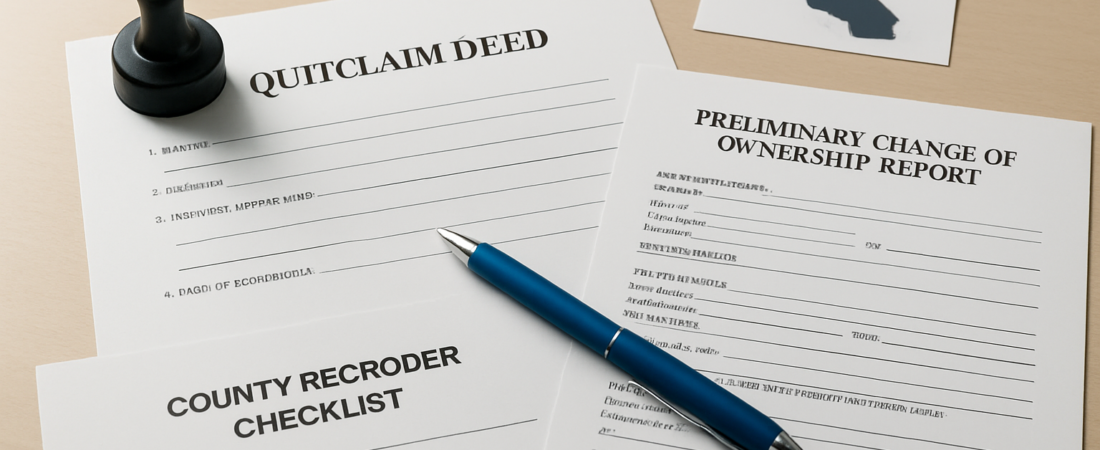
- Prepare supporting forms. In many California counties, a Preliminary Change of Ownership Report is submitted with the deed unless an exception applies.
- Sign before a notary. The grantor’s signature generally must be notarized for recording.
- Submit the deed for recording. Recording is typically done with the county recorder in the county where the property is located.
- Pay recording fees and any applicable taxes. Fees vary by county and transaction type.
What a California Quitclaim Deed Usually Contains
People researching how to prepare a quit claim deed in California often want to know what actually appears on the document. While forms can vary, a California quitclaim deed commonly includes:
- Name and address of the person requesting recording
- Return address after recording
- Space for recorder use
- Title of the document, such as Quitclaim Deed
- Name of the grantor
- Name of the grantee and vesting language
- County where the property is located
- Statement transferring any interest the grantor has
- Legal description of the property
- Assessor’s Parcel Number, if included
- Documentary transfer tax statement or exemption wording as directed
- Signature line for the grantor
- Notary acknowledgment compliant with California law
Because wording can affect recordability and legal effect, accuracy matters. A deed that is incomplete, inconsistent with the prior vesting, or missing a proper acknowledgment may be rejected or create confusion in the chain of title.
Preliminary Change of Ownership Report and Other Recording Paperwork
Preparing the deed is only part of the process. In many cases, recording also requires a Preliminary Change of Ownership Report, commonly called a PCOR. This form provides information to the county assessor about the transfer. It helps determine whether reassessment rules or exclusions may apply.
Some transfers may involve exemptions or exclusions from reassessment, but whether a transfer qualifies can be a legal or tax question. An LDA can help assemble the form package at your direction, but cannot advise you how to answer legal or tax-related questions on the form.
Depending on the county and transaction, other items may be relevant, such as:
- Recording cover sheet, if locally used
- Transfer tax affidavit or supplemental tax form
- County-specific fee notices
- Additional ownership or trust information requested by the recorder or assessor
One practical benefit of working with a California LDA is having the deed package organized in a recorder-ready manner based on the information you provide.
County Recording Requirements in California
Each county recorder may have its own procedures, fee schedules, and practical preferences, even though statewide laws still apply. That is why understanding local recording requirements is an important part of how to prepare a quit claim deed in California.
Counties may pay close attention to:
- Proper notary acknowledgment wording
- Legible print and clean copies
- Adequate top margin space for recording stamps
- Clear legal descriptions
- Correct fee payment
- Inclusion of the PCOR when required
- Transfer tax declaration language
A deed may be rejected if it is missing required information, contains an unreadable legal description, lacks a proper acknowledgment, or is submitted without required companion forms. Rejections can delay time-sensitive transactions and may require corrected documents and additional trips to the recorder.
Common Mistakes to Avoid
Many problems arise not because the deed form is unavailable, but because the details are mishandled. If you want to know how to prepare a quit claim deed in California properly, watch for these common errors:
- Using the wrong legal description. A street address is not a substitute.
- Misspelling names. Even small discrepancies can create title confusion.
- Incorrect vesting language. How title is held can have legal consequences.
- Missing notary acknowledgment. The deed usually cannot be recorded without it.
- Choosing tax wording without understanding it. Transfer tax statements and exemptions should not be guessed.
- Failing to include the PCOR. This can lead to penalties or delays.
- Recording in the wrong county. The deed must be recorded where the property is located.
- Assuming a quitclaim deed resolves all title issues. It may not.
These are exactly the kinds of practical issues that make organized document preparation valuable, even when the client already knows what document they want.
When a Quitclaim Deed May Raise Legal Questions
Although this article focuses on procedure, there are situations where legal advice is strongly recommended before signing or recording anything. These may include:
- Property acquired during marriage
- Transfers after divorce or separation
- Inherited property
- Property subject to probate or trust administration questions
- Transfers involving multiple owners
- Potential gift tax, property tax, or capital gains issues
- Concerns about mortgages, liens, or creditor claims
- Uncertainty about whether a quitclaim deed or grant deed should be used
If any of these apply, a non-attorney document preparer cannot tell you what you should do. You should get legal advice from a California attorney before proceeding.
How an LDA Can Help With Quitclaim Deed Preparation
For people who already know they want this type of deed and need help with the paperwork, an LDA can provide practical, clerical support. That support may include preparing the deed and related forms based strictly on the client’s instructions, checking for completeness of the information provided, and helping ensure the package is organized for signing and recording.
This can be especially helpful if you are overwhelmed by recorder formatting, unsure which non-legal supporting forms are commonly submitted, or simply want the paperwork typed clearly and professionally.
At the same time, it is important to understand the limits. A California LDA does not make legal decisions for you. The LDA does not choose your vesting, determine your tax exemption, or advise you whether transferring title is in your best interest. Those decisions belong to you, or to your attorney if legal advice is needed.
Practical Checklist: How to Prepare a Quit Claim Deed in California
Here is a simple checklist you can use when gathering information:
- Obtain a copy of the current recorded deed
- Confirm the full legal names of all grantors and grantees
- Confirm how the grantee will hold title, if known from legal advice or your own direction
- Verify the property’s county, address, and APN
- Copy the full legal description from a reliable source
- Determine the documentary transfer tax wording or exemption basis at your own direction or with attorney guidance
- Prepare the quitclaim deed in recordable format
- Prepare the Preliminary Change of Ownership Report if required
- Arrange notarization for the grantor’s signature
- Record the deed with the correct county recorder and pay applicable fees
Why Accuracy Matters
A quitclaim deed can affect ownership rights, future sales, refinancing, estate planning, and tax treatment. Even if the transfer seems simple, the recorded deed becomes part of the public land records. Errors can create lasting complications. That is why people often seek professional document preparation support when looking up how to prepare a quit claim deed in California.
Having a properly assembled deed package may help reduce avoidable recording issues and save time. It also helps ensure that the documents you submit are clear, organized, and based on the information you have directed.
Important Disclaimer
A Legal Document Assistant is not an attorney. A California LDA prepares documents at the client’s direction and may provide self-help services in connection with legal documents, but cannot provide legal advice, cannot tell you whether a quitclaim deed is the right transfer method, and cannot advise you about title, tax, or legal consequences. If you have questions about your rights, the effect of the transfer, or which deed should be used, you should consult a qualified California attorney.
Get Help Preparing Recorder-Ready Quitclaim Deed Documents
If you already know you need a quitclaim deed and want help assembling the paperwork, a California Legal Document Assistant may be able to help prepare the deed package at your direction. This may include the quitclaim deed itself, supporting forms commonly submitted for recording, and an organized package designed to meet county filing expectations.
For many property owners, the challenge is not just understanding how to prepare a quit claim deed in California, but making sure the paperwork is complete, legible, and ready for recording. If you need non-attorney document preparation support, la-legaldocumentassistants.com can help you move the process forward at your direction while keeping the important line clear between document preparation and legal advice.