Unlawful Detainer Document Preparation California: Understanding the Role of a Legal Document Assistant
When a landlord or tenant is facing an eviction case, timing, accuracy, and organization matter. In California, an unlawful detainer case moves quickly, and mistakes in the paperwork can cause delays, rejected filings, or missed deadlines. That is why many people searching for unlawful detainer document preparation California are looking for practical, lower-cost help with forms, filing, and procedural support without immediately retaining full attorney representation.
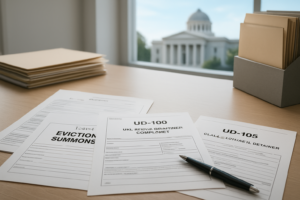
A California Legal Document Assistant, or LDA, may be able to help with that process. An LDA is a registered non-attorney professional who can prepare legal documents at a client’s specific direction. In the eviction context, that can include preparing common unlawful detainer forms such as SUM-130, UD-100, and UD-105, organizing attachments, assisting with filing logistics, and coordinating service steps as directed by the client.
However, it is essential to understand what an LDA can and cannot do. An LDA cannot give legal advice, cannot choose legal strategy for you, cannot tell you whether a notice is legally sufficient, cannot evaluate defenses, and cannot decide whether an eviction is proper under California law. Those are legal questions for an attorney. If you need legal advice about your rights, obligations, defenses, notices, rent control issues, just cause requirements, local ordinances, or trial strategy, you should consult a California attorney promptly.
This article explains how unlawful detainer document preparation California services typically work through a Legal Document Assistant, what forms may be involved, and why many landlords and tenants use this type of support when they need help preparing, organizing, and filing court paperwork.
What Is an Unlawful Detainer Case in California?
An unlawful detainer is the court process commonly used to seek possession of rental property. Most often, people refer to it as an eviction case. California unlawful detainer actions are governed by specific statutes, court rules, deadlines, and local filing procedures. Because the process is highly technical, paperwork must be completed carefully and filed correctly.
Depending on the situation, an unlawful detainer case may involve:
- A landlord seeking possession of residential or commercial property
- A tenant responding to a summons and complaint
- Claims involving nonpayment of rent, holdover occupancy, lease violations, or other alleged grounds
- Requests for damages, unpaid rent, holdover damages, attorney’s fees if allowed, and court costs
- Strict service requirements and short response deadlines
Whether you are a landlord initiating a case or a tenant preparing a response, the court forms and procedural steps can feel overwhelming. That is one reason high-intent users often search for unlawful detainer document preparation California services: they need focused help with preparing and managing the paperwork portion of the case.
What a California Legal Document Assistant Can Do
A California Legal Document Assistant helps self-represented individuals by preparing legal documents at the client’s direction. In an unlawful detainer matter, an LDA may assist with clerical and document-related tasks, including:
- Typing and preparing court forms based on information provided by the client
- Formatting attachments and exhibits
- Organizing case documents for filing
- Helping assemble filing packets
- Coordinating filing with the court at the client’s direction
- Coordinating service logistics through a registered process server or other lawful method, as directed
- Providing publicly available general information about procedure, forms, and filing requirements
For example, a landlord may already know they want to file an unlawful detainer complaint and may provide the factual details for the pleading packet. An LDA can then prepare the forms for signature and filing. Likewise, a tenant who has decided what response they want to file may use an LDA to prepare the responsive forms and organize supporting documents.
For many clients, this type of support offers a practical middle ground between doing everything alone and hiring full legal representation.
What a Legal Document Assistant Cannot Do
It is just as important to understand the limits of an LDA. A Legal Document Assistant is not an attorney and cannot provide legal advice. In the area of unlawful detainer document preparation California, that means an LDA cannot:
- Tell you whether your notice to pay rent or quit, notice to perform covenant or quit, or notice to terminate tenancy is legally valid
- Advise whether you have a winning case or a valid defense
- Recommend which claims, allegations, or defenses to include
- Interpret rent control laws, just cause rules, or local eviction ordinances for your specific facts
- Advise you on settlement strategy, trial strategy, or whether to dismiss or continue a case
- Represent you in court
- Choose forms or legal content for you without your direction
Important disclaimer: A California Legal Document Assistant is a non-attorney who prepares legal documents at the client’s direction. An LDA cannot give legal advice, cannot evaluate your rights or defenses, and cannot tell you whether an eviction is legally proper. If you have legal questions about notices, defenses, deadlines, local ordinances, rent control, or strategy, you should consult a qualified California attorney immediately.
Key Unlawful Detainer Forms an LDA May Help Prepare
One of the main reasons people seek unlawful detainer document preparation California assistance is the need to complete the correct Judicial Council forms accurately and efficiently. While the exact forms depend on the case, several are frequently used.
SUM-130: Summons – Unlawful Detainer – Eviction
Form SUM-130 is the summons used in unlawful detainer cases. It notifies the defendant that a lawsuit has been filed and explains the limited time to respond. In California eviction matters, the response period is often very short, so proper preparation and service are critical.
An LDA may help prepare SUM-130 by entering the case caption, party names, court information, and other required details based on the client’s instructions. The form must match the complaint and other filing documents exactly.
UD-100: Complaint – Unlawful Detainer
Form UD-100 is the complaint used to start many unlawful detainer cases. This is the core pleading in which the plaintiff states the basis for seeking possession and any related damages or relief requested.
Because the complaint includes legal allegations, the client must direct the content. An LDA may type and format the form and attachments based on the information the client provides, but cannot advise the client on what legal allegations should be made or whether the case is legally sufficient.
Supporting attachments may include details about the tenancy, notice served, dates, amounts claimed, and the relief requested. Accuracy and consistency across all documents are important to reduce filing issues and service problems.
UD-105: Answer – Unlawful Detainer
Form UD-105 is commonly used by defendants responding to an unlawful detainer complaint. It allows the defendant to admit or deny allegations and identify defenses.
This is an area where the line between document preparation and legal advice becomes especially important. An LDA may prepare a UD-105 based on the tenant’s or defendant’s express direction, but cannot advise which defenses apply, whether a defense is strong, or how local law affects the case. If a tenant is unsure how to respond, what defenses may exist, or whether filing an answer is the best option, attorney advice is strongly recommended.
How Unlawful Detainer Document Preparation California Services Typically Work
Although every matter is different, the process often follows a straightforward sequence. A client comes in knowing what they want prepared, and the LDA assists with the paperwork and procedural logistics.
1. Client Provides Direction and Case Information
The process begins with the client explaining what documents they want prepared. A landlord may request preparation of a summons and complaint package. A tenant may request preparation of an answer. The client supplies the facts, names, addresses, dates, and supporting documents.
Because the LDA is a non-attorney, the client is the one making legal decisions. The LDA’s role is to prepare documents according to the client’s instructions.
2. Document Review and Form Preparation
Next, the LDA reviews the materials provided and prepares the requested forms. In a typical unlawful detainer document preparation California matter, this may include entering data into SUM-130, UD-100, UD-105, and related forms, as well as assembling exhibits and attachments.
The LDA may also help ensure the packet is organized in a way that aligns with court filing requirements, including pagination, captions, and signature lines.
3. Client Reviews and Approves the Documents
Before filing, the client reviews the prepared documents for accuracy and completeness. This step matters because the client is responsible for the factual content and legal choices reflected in the paperwork.
If corrections are needed, they can be made before signatures are finalized and the filing packet is submitted.
4. Filing Coordination
After approval, the LDA may assist with filing logistics at the client’s direction. Depending on the court and the circumstances, this may involve in-person filing, e-filing coordination where available, or preparing the filing packet for submission.
Filing support can be especially helpful for clients who are unfamiliar with courthouse procedures, fee issues, or document assembly requirements.
5. Service Coordination
Service is a critical part of any unlawful detainer case. A plaintiff generally must ensure the defendant is served properly, and proof of service must be completed and filed. An LDA may coordinate service logistics at the client’s direction, such as working with a registered process server or helping organize service documents.
Again, the LDA cannot advise on legal sufficiency of service in a strategic sense, but can assist with the administrative side of moving the process forward.
Why Clients Use an LDA for Unlawful Detainer Paperwork
People searching for unlawful detainer document preparation California often want efficient, affordable help with forms and filing. Common reasons include:
- Lower cost than full legal representation: Some clients are comfortable directing their own case but want help with document preparation.
- Time savings: Court forms, attachments, and filing requirements can take significant time to prepare correctly.
- Reduced paperwork stress: An organized filing packet can make the process more manageable.
- Administrative support: Filing and service coordination can help clients stay on track in a fast-moving case.
- Help for self-represented litigants: Landlords and tenants who have decided to proceed without an attorney may still want professional document preparation assistance.
For many users, this is exactly the appeal of a California Legal Document Assistant: practical support with the paperwork while keeping legal decision-making in the client’s hands.
Important California-Specific Considerations
California eviction law is not one-size-fits-all. In addition to statewide unlawful detainer rules, many cases are affected by local city or county ordinances, rent stabilization rules, just cause protections, and special notice requirements. Courts may also have local filing preferences or procedural rules.
That is why the distinction between document preparation and legal advice is so important. If you are unsure about any of the following, you should speak with an attorney:
- Whether the notice served was legally proper
- Whether state or local rent control laws apply
- Whether just cause eviction rules limit the case
- Whether the complaint states a valid claim
- Whether defenses such as defective notice, improper service, habitability, waiver, retaliation, discrimination, or payment issues may apply
- Whether emergency rules, local tenant protections, or subsidy rules affect the case
An LDA can help with unlawful detainer document preparation California tasks, but legal analysis requires a licensed attorney.
Tips for Getting the Most Out of Document Preparation Services
If you decide to use an LDA for unlawful detainer paperwork, preparation on your side can make the process smoother and faster. Consider gathering the following in advance:
- The lease or rental agreement
- The notice that was served, if any
- Proof of service of the notice
- A rent ledger or payment history if relevant
- Names of all parties and occupants
- The property address and mailing addresses
- Prior court paperwork, if the case has already been filed
- Any deadlines listed on filed documents
- Clear instructions on which forms you want prepared
The more complete and organized your information is, the easier it is to prepare accurate forms and avoid delays.
When You Should Contact an Attorney Instead of Relying Only on Document Preparation
There are many situations where attorney involvement is strongly advisable. You should consider speaking with a lawyer right away if:
- You are unsure whether you have a legal right to evict or a legal defense to eviction
- The case involves rent control, subsidized housing, or local tenant protections
- You need help evaluating notices or deadlines
- You expect the matter to be contested
- You need representation at trial or a hearing
- You are dealing with a commercial tenancy or a large damages claim
- You want advice on settlement, dismissal, default, or post-judgment procedures
In short, if your question begins with “Can I,” “Should I,” “Is this valid,” or “What is my best strategy,” you likely need legal advice rather than only document preparation.
Choosing the Right Help for Unlawful Detainer Document Preparation California
If you are looking for unlawful detainer document preparation California services, choose a provider that clearly explains the scope of assistance. The service should be transparent that it is non-attorney document preparation, not legal representation. You should understand what documents will be prepared, what filing or service coordination is available, and what remains your responsibility as the client.
For self-represented landlords and tenants who already know what they want filed, a California Legal Document Assistant can provide valuable support with the paperwork side of the process. That support can help reduce clerical errors, save time, and make filing more manageable during a stressful situation.
Final Thoughts
Eviction cases move fast, and the paperwork matters. If you are a landlord or tenant who needs help preparing, organizing, and filing court forms, unlawful detainer document preparation California through a registered Legal Document Assistant may be a practical and cost-conscious option. An LDA can assist with forms such as SUM-130, UD-100, and UD-105, and may also help coordinate filing and service at your direction.
Just remember the key limitation: an LDA is a non-attorney and cannot provide legal advice, strategic recommendations, or opinions about whether an eviction is legally proper. If you have questions about notices, defenses, deadlines, local rules, or your legal rights, consult a qualified California attorney.
For clients who know what documents they need and want reliable help with preparation and process, an LDA can be an efficient bridge between handling everything alone and hiring full legal counsel.