@Junhui Joo
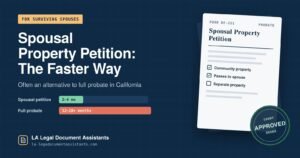
When a husband or wife dies in California, many surviving spouses assume they must go through full probate. Often they don’t. A spousal property petition asks the court to confirm that property passes to the surviving spouse without a full probate case. It typically takes about two to four months instead of the 12 to 18 months a probate case often takes.
In our companion article, we told the story of Elena, a young widow whose case got stuck in full probate. This guide explains the tool that helps many surviving spouses avoid her experience, when it works, and when it doesn’t.
Spousal Property Petition vs. Full Probate
| Spousal property petition | Full probate | |
|---|---|---|
| Typical time | About 2 to 4 months | Often 12 to 18 months or more |
| Main form | DE-221 | DE-111 |
| Court hearings | Usually one | Several |
| Newspaper publication | Generally not required | Required |
| Probate referee appraisal | Not required | Required |
| Statutory attorney and executor fees | Do not apply | Set by formula on the gross estate |
| Court filing fee | Yes, about $435 in many counties | Yes, plus publication and referee costs |
| What you receive | Spousal Property Order (DE-226) | Letters, then a final distribution order |
The fee difference can be large. On a $650,000 home, California’s statutory formula allows a $16,000 attorney fee in full probate, plus the same amount for the executor. A spousal property petition has no statutory fee formula, so professional fees are set by agreement.
Who Qualifies, and What Property It Covers
The petition is available to a surviving spouse or registered domestic partner. Whether it works for a particular asset depends on two things: whether the property is community or separate, and who inherits it.
Community property. Property acquired during the marriage is generally community property. The surviving spouse already owns half. If the deceased spouse’s half also goes to the survivor, either by will or because there was no will, the petition can confirm the whole asset belongs to the survivor.
Separate property. Property owned before the marriage, or received by gift or inheritance, is generally separate property. The petition covers it only to the extent it passes to the surviving spouse.
This is where families get surprised. Without a will, a surviving spouse does not always inherit all of the separate property:
| Deceased spouse also left… | Surviving spouse receives | Others receive |
|---|---|---|
| No children, parents, siblings or their children | All | None |
| One child (or that child’s descendants) | One-half | One-half to the child |
| Two or more children | One-third | Two-thirds shared by the children |
| No children, but a parent | One-half | One-half to the parent(s) |
The share that goes to children or other relatives cannot be confirmed through a spousal property petition. That is exactly what happened to Elena, whose husband’s condo was his separate property.
The Process, Step by Step
- Gather documents and list the assets. Identify each asset, how it is titled, and whether it is community or separate property.
- Prepare Form DE-221, the Spousal or Domestic Partner Property Petition. Describe each asset and explain why it passes to you. Attach a copy of the will if there is one, and any written agreement between the spouses about property.
- File in the right county. This is usually the Superior Court in the county where your spouse lived. Pay the filing fee or request a fee waiver.
- Give notice. Mail Notice of Hearing (Form DE-120) to the people entitled to it, such as heirs and anyone named in the will, at least 15 days before the hearing.
- Check the probate notes. Many courts, including Los Angeles, post notes before the hearing listing anything missing. Fixing these early can keep your hearing from being postponed.
- Attend the hearing. If everything is in order and no one objects, the judge grants the petition. Many uncontested petitions are approved without a long appearance.
- Get the Spousal Property Order (Form DE-226). For real estate, record a certified copy with the County Recorder. Give copies to banks and other institutions to retitle accounts.
When a Spousal Property Petition Is Not the Right Tool
- Part of the property goes to someone else. If children, parents or others inherit part of an asset, their share needs probate or another process.
- A probate case is already open. The petition must then be filed within that probate case.
- The assets are already in a living trust. The trustee handles trust assets without a court petition.
- The asset has a beneficiary. Life insurance, retirement accounts and accounts payable on death go straight to the named beneficiary.
- Joint tenancy or community property with right of survivorship. These often transfer with a simple affidavit and a death certificate.
- There are significant debts. A surviving spouse who takes property through this petition can become personally responsible for the deceased spouse’s debts, up to the value of the property received. In full probate, creditors must generally file claims within a set period. If debts are large, talk to an attorney before choosing this route.
Documents to Gather
- Certified death certificate
- Marriage certificate or domestic partnership registration
- The original will, if there is one
- Grant deed for any real estate, plus the property’s legal description and parcel number
- Recent statements for bank and investment accounts
- Vehicle titles and registrations
- Any prenuptial, postnuptial or other written property agreement
- Names and addresses of the deceased spouse’s children, parents and other heirs
- Information on debts: mortgage statements, credit cards and loans
Frequently Asked Questions
Do I need a spousal property petition if my spouse left everything to me in a will? Often, yes. A will does not avoid court by itself. If assets were titled only in your spouse’s name, a bank or title company will usually want a court order before transferring them.
Is there a dollar limit? No. Unlike the small estate affidavit, a spousal property petition has no maximum value.
Can I sell the house before the order is granted? Generally not. Title companies usually require the recorded spousal property order before a sale or refinance.
Can I file it myself? Yes. Many surviving spouses file on their own or with help from a registered legal document assistant. If there are disputes, large debts or complicated property questions, consult an attorney.
What if someone objects? If a child or other relative disputes whether property was community or separate, the court may set further hearings. Contested cases usually need an attorney.
How a Legal Document Assistant Can Help
A spousal property petition is one of the most useful and least known tools for surviving spouses. A registered legal document assistant can prepare your petition, notices and order accurately, at your direction, and help you avoid delays from missing items.
- Preparing Forms DE-221, DE-120 and DE-226
- Organizing your asset list and supporting documents
- Filing with the court and tracking probate notes
- Recording the final order with the County Recorder
[Call us at (XXX) XXX-XXXX or visit our office at [ADDRESS] to schedule a consultation.]
Disclosure: I am not an attorney. I can only provide self-help services at your specific direction. LA Legal Document Assistant, Registration No. [____], Los Angeles County, expires [date]. This article is general information, not legal advice. For legal advice about your situation, consult a licensed California attorney.