
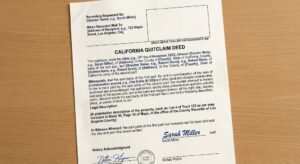
Physical Document Requirements
-
Paper Size and Weight: The document must be printed on standard 8.5-inch by 11-inch paper. The paper must be standard weight (usually 20 lb. bond); extremely heavy cardstock or extremely thin tracing paper is not acceptable.
-
Ink and Legibility: All text, signatures, and notary seals must be in black or dark blue ink. The document must be highly legible and capable of reproducing a clear photographic record. Faded prints or smudged ink will result in immediate rejection.
-
Font Size: The text of the document must be printed in a minimum of 10-point font.
-
First Page Margins: The most critical formatting rule involves the top right corner of the first page. You must leave a blank space measuring exactly 2.5 inches down from the top edge and 2.5 inches across from the right edge. This space is exclusively reserved for the Recorder’s official recording stamp. The top left corner of the first page (above the document title) must contain the name and address of the person requesting the recording and the name and address of where the recorded document should be mailed after processing.
-
Subsequent Margins: All other margins on the first page, and all margins on any subsequent pages, must be at least 0.5 inches. No text, signatures, or notary seals can bleed into these margins.
Essential Components of the Deed
-
Assessor’s Parcel Number (APN): The 10-digit APN must be clearly printed on the first page of the deed. This number identifies the specific piece of land for property tax purposes. You can find this number on your most recent property tax bill.
-
Legal Description: A simple street address is not legally sufficient to transfer property. The deed must include the full legal description of the property (e.g., “Lot 4, Tract No. 12345, as per map recorded in Book 50, Page 10 of Maps, in the office of the County Recorder of said County”).
-
Documentary Transfer Tax (DTT) Declaration: Every deed submitted for recording in California must include a declaration regarding the Documentary Transfer Tax. This declaration is typically found just below the return address area. You must state the computed tax amount or state the specific legal reason the transfer is exempt.
Documentary Transfer Tax and Common Exemptions
| Exemption Type | Applicable Revenue & Taxation (R&T) Code | Common Scenario |
| Gift Transfer | R&T Code 11930 | Parents gifting a home to their children for zero consideration. |
| Transfer to a Trust | R&T Code 11930 | Moving personal real estate into a revocable living trust for estate planning. |
| Name Change | R&T Code 11911 | Changing a legal name on the title after marriage or a court order, with no change in actual ownership. |
| Spousal/Divorce Transfer | R&T Code 11927 | Removing a spouse from the title pursuant to a marital settlement agreement. |
The Preliminary Change of Ownership Report (PCOR)
-
Part 1: General Information: You must provide the contact information for the buyer/transferee, the APN, and the property address.
-
Part 2: Transfer Information: This section contains a series of yes/no questions designed to identify if the transfer qualifies for an exclusion from reassessment. For example, there are specific checkboxes for transfers between spouses, transfers into a trust, or transfers between parents and children (which may require additional Proposition 19 claim forms).
-
Part 3: Purchase Price and Terms of Sale: If the property was sold, you must detail the purchase price, down payment, and financing. If it was a gift, you will indicate that here.
Execution and Notarization
The Recording Process in Los Angeles County
Submission Methods
-
In-Person Recording: You can bring your documents directly to the Norwalk headquarters or one of the branch offices (such as the LAX Courthouse, Lancaster, or Van Nuys locations). In-person recording is highly recommended because the clerk will review your document at the counter. If there is a minor formatting error, you will know immediately and can often fix it the same day.
-
Recording by Mail: You can mail your original notarized deed, the PCOR, and a check for the recording fees to the Norwalk headquarters. If you choose this route, it is vital to calculate your recording fees perfectly. If your check is short by even a single dollar, the entire packet will be rejected and mailed back to you, delaying the transfer by weeks.
Understanding Recording Fees
| Fee Category | Cost | Description |
| Base Recording Fee | $15.00 | Covers the recording of the first page of the document. |
| Additional Page Fee | $3.00 | Charged for every subsequent page of the deed (including the notary acknowledgment page). |
| Real Estate Fraud Fee | $10.00 | A mandatory county fee applied to all real estate transfers to fund the district attorney’s real estate fraud prosecution unit. |
| SB2 Building Homes and Jobs Act Fee | $75.00 | A state-mandated fee applied to most real estate documents. Exemptions exist if the transfer is subject to Documentary Transfer Tax or if it is transferring a primary residence. |
| Missing PCOR Penalty | $20.00 | Applied only if you fail to submit a completed BOE-502-A with your deed. |

Note for LDAs: If you are asked to prepare deeds, it is highly recommended that you retain all related records. While LDAs are not legally required to keep signed copies of deeds, doing so is a vital protective measure.
For example, I once prepared a Quitclaim deed at the wife’s request to transfer property into her name, which the husband signed and had notarized the following day. A year later, the spouses became entangled in civil and criminal litigation. The husband alleged fraud, leading the LAPD to seize my notary journal and question me about a forged deed that I had no part in creating. Fortunately, because I kept the original digital file on my computer, I could prove exactly what I had drafted. Even though I had simply prepared a valid deed according to the client’s instructions, I was subjected to subpoenas from a civil attorney and wasted significant time. Keeping thorough records ultimately protected me from unwarranted legal trouble.